For asset-heavy manufacturers, e.g. in automotive, heavy machinery, aerospace, and energy, downtime is the ultimate margin killer. When a critical forging press or robotic assembly line halts unexpectedly, the losses don’t just accumulate in repair costs, they plunge down on supply chains, breach service-level agreements, and waste massive amounts of operational energy.
In order to improve on this, many manufacturers already invested into Digital Twins: virtual replicas designed to mirror physical assets, ingest machine or sensor telemetry, and alert engineers before crucial failures occur.
However, many early digital twin deployments hit a frustrating wall: they became passive digital silos. A digital twin that only understands a single pump from a single vendor, totally isolated from the rest of the factory floor and limited to displaying basic status updates, offers minimal real-world value.
To achieve real impacting downtime reduction, the industry is shifting toward interoperable digital twins that evolve from mere mirrors into active system drivers.
The Paradigm Shift: Reflective vs. Proactive Digital Twins
To understand why traditional Digital Twins fail to eliminate downtime, it helps to examine how the term itself has evolved. Finnish Digital Twin platform pioneer BaseN draws a sharp distinction between two fundamental types of digital twins:
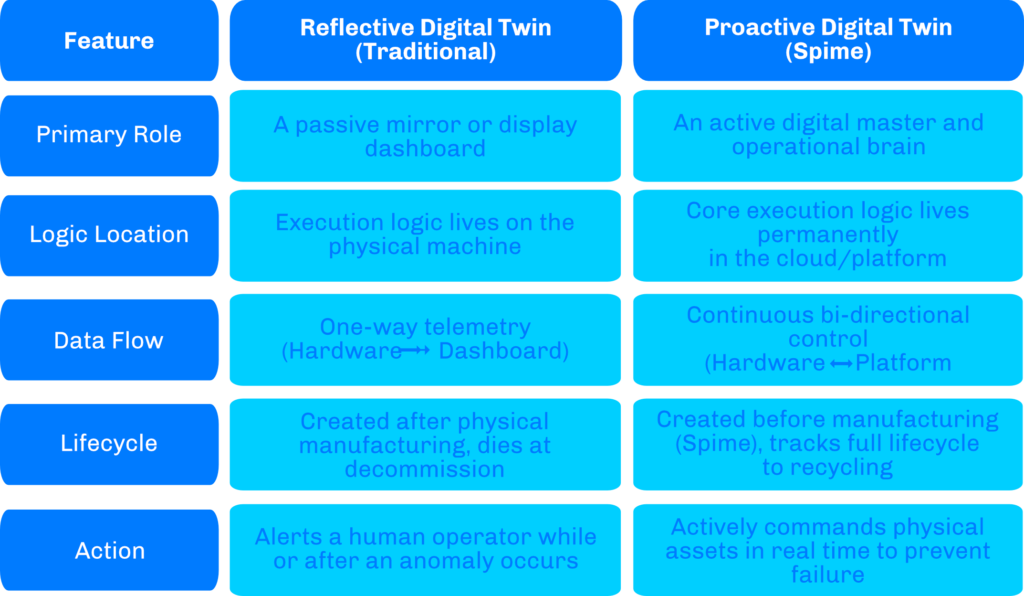
A reflective digital twin merely watches the machine break and sends you an alert. A proactive digital twin holds the asset’s digital identity and active control logic, intervening automatically before the break ever happens.
The “Siloed Mirror” Trap
Modern industrial plants are marvels of multi-vendor engineering. A single production line might feature PLCs from Siemens, robotic arms from FANUC, drive systems from ABB, and legacy hydraulic systems built decades ago.
When manufacturers implement proprietary Digital Dwin solutions provided by individual equipment OEMs, they often end up with a fragmented ecosystem of purely reflective dashboards:
-
Incompatible Data Formats: Vibration data from Machine A cannot be correlated with thermal data from Machine B
-
Context Blindness: A reflective twin might flag an overheating motor without understanding that an upstream conveyor belt slowed down, causing the overload
-
Maintenance Alarm Fatigue: Technicians are forced to monitor six different vendor dashboards, leading to missed warnings and delayed responses
A Digital Twin is only as useful as the holistic context it possesses. Interoperability is the bridge that turns isolated data streams into proactive, enterprise-wide intelligence.
Interoperable digital twins rely on open standards and unified platform architectures rather than closed, vendor-locked software. Key technologies enabling this seamless communication include:
-
Asset Administration Shell (AAS): A standardized digital representation of an asset that acts as its unified interface, allowing different software tools to access its parameters, documentation, and real-time state regardless of the manufacturer
-
Unified Data Architectures (OPC UA & MQTT): Industrial communication protocols that ensure data generated at the edge can flow securely into cloud or on-premise execution environments without needing custom translation code for every device
-
Semantic Data Modeling: Giving raw data numbers real-world context. Instead of simply logging
34.2, the system understands that34.2refers toDegrees CelsiusonBearing #2ofCNC Machine 4
4 Ways Proactive, Interoperable Twins Reduce Unplanned Downtime
When digital twins across an entire ecosystem speak the same language and possess proactive control logic, maintenance evolves significantly:
1. Root-Cause Analysis Across the Entire Line
When a high-value asset fails, the root cause is rarely found within the machine itself. It is usually caused by an anomaly elsewhere in the workflow. An interoperable digital twin environment tracks data streams across the entire line, allowing algorithms to correlate a spike in motor temperature on Machine C to a subtle power fluctuation from Machine A three hours earlier.
2. Predictive Maintenance Driven by Ecosystem Data
Reflective twins rely on basic static thresholds (e.g., “If temperature exceeds 80°C, send alert”). Proactive twins combine real-time sensor streams with historical maintenance logs, ambient environmental data, and upstream operational speeds. This allows maintenance teams to schedule interventions during natural line pauses rather than waiting for an emergency shutdown.
3. Automated Closed-Loop Control
The true power of BaseN’s proactive definition is two-way execution. Because the twin holds the primary logical model, it doesn’t just passively report data, it commands hardware. If an interoperable twin detects critical wear on a bearing, it automatically triggers the control logic to lower the machine’s RPM by 10%, keeping the line running safely at reduced capacity until the scheduled night shift.
4. True Lifecycle Management (The Spime Paradigm)
Industrial pioneers are taking proactive interoperability a step further by viewing assets as Spimes – permanent digital master entities that dictate physical asset behavior from creation to disposal. The digital model holds the master blueprint and complete history of the asset, from raw material supply chain origins to continuous operational telemetry. When a part wears out, the Digital Twin automatically knows the exact part specification, vendor lead time, and maintenance history, streamlining the repair workflow long before the part physically breaks.